
AI-Driven Forecast Battery Thermal Runaway
Dec 2024
We propose an AI-driven intelligent framework for predicting the temperature distribution and thermal runaway propagation in a battery pack across different battery types, ambient temperatures, and fire powers. We highlight the AI method in improving the battery safety management, thereby facilitating timely interventions, preventive maintenance and fire safety of battery energy storage system. This work is led by Zilong in collaboration with Dr. Francesco Restuccia and is now open access in Engineering Applications of Computational Fluid Mechanics.

GABES Organized the Intelligent Fire Drill
Dec 2024
The PolyU X Fire Group and GABES (PolyU Startup) organized the first Hong Kong's Smart Dynamic Exit Sign System Showcase in Pui Ying Secondary School. More than 100 guests from fire services industries, infrastructure developers, and government departments joined the show, and the demonstration was a great success. This marked a great step towards smart fire emergency practices in Hong Kong and the world.

Smart Dynamic Exit Signs Proved in Tunnel
Dec 2024
Emergency exit sign systems guide occupants to safety, but they may fail in fire and smoke. We introduce an Intelligent Dynamic Exit Sign (IDES) System, integrating a fire-detection sensor network with dynamic sign patterns, which could enhance evacuation safety by always guiding occupants away from hazards and demonstrated in a tunnel model. This is a first step towards real-world implementation and offers insights for future applications of this innovative fire safety solution. This research is led by Ho Yin and now open access in Journal of Safety Science and Resilience.

214 IJHMT 2024 BTM topology optimization
Dec 2024
The battery thermal management is still a big challenge. We propose a battery cold plates designed using topology optimization across laminar and turbulent flow regimes and find the best cooling design. This work is in collaboration with Prof. Menglong Hao from Southeast University and now published in the International Journal of Heat and Mass Transfer.

SureFire Team Attend TRS Symposium
Dec 2024
The SureFire team attended the Theme-based Research Scheme (TRS) Annual Public Symposium in HKUST. TRS aims to focus academic research efforts of University Grants Committee funded universities on themes of strategic importance to the long-term development of Hong Kong. TRS is the largest funding scheme in HK (>30 M), and there are four designated research themes under the TRS. Asif and Xinyan gave the presentation on latest development of SureFire smart firefighting projects.

Intra-cell propagation of Thermal Runaway
Nov 2024
We are happy to share our latest battery fire research on The thermal runaway in batteries presents significant safety concerns. We found that the intra-cell propagation process with a rate of 1-10 cm/s is very similar to premixed flame propagation or the burning of solid propellant. This work is led by Lei and now published in International Journal of Thermal Sciences.

Digitized Fuel load Assessment
Nov 2024
Fuel load significantly affects fire development in compartments, and its design value derives from statistical results of numerous surveys. Our work enhances the fuel load database by employing a digitized survey method to assess 27 university and commercial offices in China. Overall, it provides a valuable database for future fire scenario design, fire codes edition, and fire safety assessment. This work is funded by NFPA student research project and led by Yifei, published in Fire Safety Journal.


Event Camera Flame Detect
Nov 2024
We recently developed a Hyper real-time flame detection method using Dynamic insights from event cameras and FlaDE dataset. Bio-inspired event cameras offer significant advantages in detecting moving objectives like the flame and smoke. This work is led by Saizhe in collaboration with University of Science and Technology of China and now published in Expert Systems with Applications.

Perspectives of Wildfire Digital Twin
Oct 2024
Our latest review on Digital Twin Systems for Wildland Fire management discusses the technological perspective, and we hope to inspire more future research and implementation of smart wildfire fighting. This work is led by Yizhou and now open-access in the Journal of Forestry Research.

Group Attended European Fire Symposium
Oct 2024
Yuxin and Lei attended the 4th European Symposium on Fire Safety Science (ESFSS 2024) in Barcelona (Spain) and presented the latest research on battery fire safety. This is the first European conference we attend after the Covid. More new research will be presented in the next ESFSS Ljubljana (Slovenia).

Competing Guidance for Evacuation with VR
Oct 2024
Yanfu defended his PhD Thesis, titled “Intelligent Building Fire Safety Design Driven by Deep Learning Methods”. His thesis was rated as excellent. Yanfu’s research marks the beginning of exploring AI implementation in building fire safety design, which will lead to a better, smarter, and more automated future! Thank Prof. Eric Lee and Prof. Negar Elhami-Khorasani for serving as the examiners.

Xinyan got Dean’s Award for Research Funding
Oct 2024
Efficient emergency guidance in buildings is essential for the safe evacuation of occupants. In this VR study, participants chose between two potential exits under time pressure in each trial. Research outcomes can significantly inform the design and optimization of egress guidance systems. This work is led by Dr Yuxin Zhang in collaboration with Brown University and National Research Council Canada, which is published in Expert Systems with Applications.

Review of Hydrogen Jet and Diffusion Model
Oct 2024
Renewable Power-to-Hydrogen system is an emerging decarbonization strategy while having major safety issues. This study develops a physics-informed graph neural network for H2 jet and diffusion prediction using sparse sensor data. It enables accurate and rapid prediction of H2 dispersion, supporting safety design, operation management and rulemaking of H2 system in future. This work is in collaboration with China University of Petroleum and now published in Renewable and Sustainable Energy Reviews.

Yanhui Defend PhD viva on Battery Fire Safety
Oct 2024
Yanhui defended his PhD Thesis, titled “Fundamental Study of Battery Fire Safety under the Low Ambient Pressure”. His thesis was rated as excellent. Yanhui’s research highlights a comprehensive understanding of battery fire safety under low-pressure transportation and storage, which will lead to a better, safer, and more sustainable future! Thank Prof. Yang JIN from Zhengzhou University and Dr. Monica Marinescu from Imperial College London for serving as the external examiners and Prof. LT Wang serving as Chair.

3rd Prize in EV Battery Safety competition
Sep 2024
The PolyU Fire Team attended the Competition of EV Power Battery Safety Prediction Algorithm, organized by the State Administration for Market Regulation (Innovation Center). The algorithm developed by Mengyao and other team members was shortlisted in the final round of competition and won the 3rd Prize. Now, we are working with different companies to further improve the safety of EV and battery energy storage system (BESS).

Fire Interaction with Rain in dead-end tunnel
Sep 2024
When a tunnel fire meets the local extreme weather, the disaster may escalate. We study the smoke movement and stratification of tunnel fires under the coupled effects of rainfall and ventilation. This work is led by Diane Luan (visiting student from Central South University) and Jakub Bielawski (visiting student from ITB Poland) and now published in Fire safety Journal.

Yifei Won Best Presentation Award
Sep 2024
Yifei attended the National Symposium of Thermal Safety in Hefei and gave a presentation of “AI-Driven Digitized Fire Fuel Load Survey: Data Collection and Statistic Analysis”. His presentation won the Best Presentation Award. Back in 2021, Zilong’s presentation on AI-Image Fire Calorimetry won the same Award in the same conference.

Weikang Attended Summer School & CONFAB2024
Sep 2024
Weikang attended the 2024 Summer School in Warsaw with the theme of “Fire Fundamentals for Performance-Based Fire Safety Design,” a collaborative initiative between ITB and FRISSBE. Then, he went to London to attend 4th International Conference on Structural Safety Under Fire & Blast Loading (CONFAB2024) and gave a presentation on our latest smart firefighting system. A wonderful trip!

How a Fast-Moving Particle Ignites a Foam
Sep 2024
Our experiments found a high-speed particle can directly get embedded into the foam to ignite the plastic form, while a low-speed particle bounces away from the foam without ignition. This research deepens our knowledge of the complex interaction between hot moving particles and insulation foam to reduce spotting fire risk for building façade. The paper is published in the Fire Safety Journal in collaboration with Nanjing Tech University.

Yanfu’s PhD Thesis rated Excellent
Aug 2024
Yanfu defended his PhD Thesis, titled “Intelligent Building Fire Safety Design Driven by Deep Learning Methods”. His thesis was rated as excellent. Yanfu’s research marks the beginning of exploring AI implementation in building fire safety design, which will lead to a better, smarter, and more automated future! Thank Prof. Eric Lee and Prof. Negar Elhami-Khorasani for serving as the examiners.

Analytical Solution for blowing off smoldering
Sep 2024
We develop a reduced analytical model to predict the extinction limits of smoldering. The model simultaneously solves smoldering propagation rate, surface temperature, and surface oxygen mass fraction as part of the solutions. The extinction limit is determined as the critical condition where solutions satisfying all governing equations cease to exist. This collaborative work with Tokyo University of Science is now Open Access in Combustion and Flame.

Welcome New PhD students
Sep 2024
This year, we welcome six new PhD students to the fire group. GENG Mengyao, ZHANG Yichao, DING Saizhe, LU Tong, DENG Rong, LIU Changlin. They will work on different research topics in Smart Firefighting, Wildland Fire, and Battery Fire Safety. Please see more information about them in our Team Webpage.

New Barrier for Battery Thermal Runaway
Aug 2024
We develop a novel flame-retardant epoxy resin board to prevent the battery thermal runaway propagation. The composite shows 100+% increase in char yield, 57% decrease in peak heat release rate, 57 % reduction in peak CO production rate, and a 3-mm board can stop thermal runaway propagation in 103450-pouch cells. This collaborative work with Nanjing Tech University is now published in the Chemical Engineering Journal.

New paper Modelling Smoldering Limits
Aug 2024
We built a physics-based computational model integrating heat-and-mass transfer and multi-step chemistry to reveal the oxygen threshold or smothering limit of smoldering propagation. This work helps deepen our understanding of the limiting conditions of smoldering combustion, thus improving the mitigation strategy of smoldering fire and the efficiency of applied smoldering systems. This work is led by Yunzhu and Shaorun and now published in the Combustion and Flame.

Dr Congliang Ye Received NSFC Fund
Aug 2024
Dr Ye received the prestigious Young Scientists Fund from the National Natural Science Foundation of China (NSFC) for this research on fire explosion dynamics. Congliang joined PolyU Fire Group in early 2023, and his research focuses on the explosion hazard in battery energy systems. The success rate of this funding scheme is about 15%, and this is also Congliang’s first time to apply.

Understanding Nail Penetration on Battery
Aug 2024
This work compares the thermal runaway dynamics under nail penetration with different nail diameters, materials, and cell SOCs. It deepens the understanding of the safety of batteries under external shocks and provides new scientific insights into battery design and its safety testing. This work is led by ZHANG Lei and LIU Yanhui, now published in International Journal of Heat and Mass Transfer.

Yichao Got Best Presentation Award
Aug 2024
Yichao and Xinyan attended the 17th International Peatland Congress in Taizhou, China. Yichao gave a presentation on “Impact of Underground Wildfire on Plant Roots in Peat Soil” and won the Best Student Oral Presentation Award. Yichao was a visiting student in Fire Lab back in 2022 and now joins us as a PhD student. Congratulations!

How to Scale the Burning of Solid Fuel
Aug 2024
We investigated the horizontal fuel size effect on free-burning fires for PMMA plates and wood cribs and discovered a new correlation of flame height with the fire heat release rate and fuel size. This study quantifies the size effect on the burning rate for common solid fuels and provides valuable information for the numerical modeling of multi-scale fires. This work is led by Peiyi and Tianhang which is Open Access in the Journal of Thermal Analysis and Calorimetry.

Fire Lab Attending Thermal Safety Meeting
Aug 2024
Seven members from PolyU Fire Lab attended the 3rd National Symposium on Thermal Safety Science and Technology in Hefei. Xinyan gave a keynote talk on AI-driven Smart Firefighting. Xiaoning and Yifei also shared their latest research on smart tunnel digital twins and automatic fuel load assessment.

PolyU Fire Joined Fire Asia
July 2024
A big team from PolyU Fire Lab attended the Fire Asia 2024 conference, organised by HK Fire Services Department. We presented seven posters on our latest research outcomes in smart firefighting, battery fire safety, firefighting robots, and AI-driven fire safety design to guests from all around the world. This is the largest event on Fire Safety organised in HK every three years.

Apply AI to help Battery Cooling
July 2024
An efficient battery thermal management system (BTMS) is essential to ensure the optimal performance and safe operation of Li-ion batteries. We employ an Artificial Neural Network (ANN) model to train the numerical database of 8080 cases and identify the optimal combination that balances cooling efficiency and energy consumption. This work is led by Shakeel and Yanhui and is now published in the International Communications in Heat and Mass Transfer.

PolyU Fire Organized SureFire Workshop
July 2024
It is a great pleasure for PolyU Fire Lab to host the 2nd International Smart Firefighting Workshop (SureFire 2024) in PolyU, which aims to tackle future urban fire threats and enhance smart firefighting capabilities. Over 70 international research experts and scholars presented emerging topics in fire safety, covering areas in fire safety design, thermal safety management for battery systems, and AI fire forecasting.

A Reduced Network Model for Battery Fire
July 2024
We introduce a highly accurate reduced-order thermal runaway network (TRN) model by redistributing heat source terms and correcting thermal runaway trigger criteria. The TRN model with high accuracy and reliability, can facilitate the development of onboard thermal runaway warning systems and provide valuable insights for thermal runaway inhibition, guiding the thermal safety design of lithium-ion battery power systems. This work, in collaboration with the Hong Kong University of Science and Technology, is published in Applied Energy.

UAV Review won SFPE Bono Award
July 2024
The paper “Use of Unmanned Aerial Systems in Outdoor Firefighting”, co-authored by Dr Xinyan Huang and overseas collaborators, won 2024 Jack Bono Award for Engineering Communication from SFPE. This award recognises authors who have most contributed to the advancement and application of professional fire protection engineering. This is the 2nd time of winning this award, since the 2021 award paper “A Review of Battery Fires in Electric Vehicles.”

Mulch Ignition in WUI Fire
July 2024
Spotting ignition by firebrands is a significant fire spread pathway at the wildland-urban interface (WUI), where mulch products are commonly used as landscaping materials. Our latest work advances the fundamental understanding of the ignition and burning behavior of landscaping mulches and thus contributes to the prevention of extreme WUI fire events. This paper is led by Shaorun in collaboration with UC Berkeley, which is now Open Access in Fire Safety Journal.

Open Access Database for Evacuation
June 2024
We propose a novel image dataset called the Human Behaviour Detection Dataset (HBDset), specifically collected and annotated for public safety and emergency response purposes. The developed open HBDset has the potential to enhance public safety, provide early disaster warnings and prioritise the needs of vulnerable individuals during emergency evacuation. This work is led by Yifei and Xinghao and is now Open Access in the Journal of Safety Science and Resilience.

Welcome New Summer Internship Students
June 2024
We welcome two overseas undergraduate students to do their summer internship in PolyU Fire Lab. Miss Janice Ma from the University of Cambridge will be working on the robotic firefighting project. Miss Xiaoyu Sun from Glasgow University will study the impact of major fire incidents on social media. A Big Welcome!

Phased Evacuation in High-rise Building
June 2024
Evacuation in high-rise buildings is a critical safety issue due to multiple floors and high occupant density. Phased evacuation strategies can mitigate this challenge. Our new study demonstrates the effectiveness of phased evacuation and paves the way for future applications to ensure occupant safety in fire emergencies. This work is led by Fuqiu and Yuxin and is now published in the Journal of Building Engineering.

Advanced Use of AI to do Fire PBD
May 2024
A long-term goal of our group is to automatise the performance-based design of fire engineering. Here, we train AI models to predict the soot visibility slices for new fire cases in buildings of different atrium shapes, symmetricities, and volumes. This work demonstrates the potential of leveraging AI technologies in building fire safety design, offering significant cost and time reductions and optimal solution identification. This work, led by Yanfu, is in collaboration with Tsinghua University and Open Access in Journal of Computational Design and Engineering.

Wilson & Ho Yin Got Government Scholarship
May 2024
Wilson and Ho Yin received the 2024 Talent Development Scholarship from HKSAR Government. This scholarship aims to recognize students not only for their outstanding academic performance but also for their achievements and talents in non-academic areas and provide support for these students to further develop their talent and potential. Congratulations!

From Spotting to Wildfire Spread
May 2024
The prediction of the propagation of wildland fires is an important socio-technical problem. Wildland fires are often initiated by small spot ignition sources and then spread to larger burning areas. We found that wildfire spread has an initial acceleration phase, with the growth of the burned area in the fuel bed following a power law dependence in time, almost independent of the ignition source. This work is in collaboration with Universidad Adolfo Ibáñez and UC Berkeley, which is Open Access in the International Journal of Wildland Fire.

How to Assess Dynamic Tunnel Fire Safety
May 2024
We propose a novel method using computer vision for assessing the real-time tunnel fire risk and evacuation safety by considering the classification and entry flow of vehicles. The system is demonstrated in real road tunnels with traffic video cameras and exhibits a robust performance. The proposed vision-based real-time tunnel fire risk evaluation enables intelligent daily fire safety management and supports fire emergency response and decision-making. This work is led by Xiaoning in collaboration with Lund University and has now been published in Safety Science.

Shaorun Won the Bernard Lewis Fellowship
May 2024
Shaorun received the 2024 Bernard Lewis Fellowship from the Combustion Institute. Congratulations!
This prestigious recognition is assessed biennially and rewards young scholars who obtained a PhD degree within three years, have contributed high-level research, and have outstanding academic potential. Xinyan won this fellowship back in 2018.

Let’s talk to Chatbot about Fire Engineering
May 2024
We talked to Chatbots and saw how much it knew about fire safety engineering. They demonstrate a relatively superior performance of 88% (vs. 80% for Bard). Evidently, and when it matures, this technology will likely be elemental to our engineers’ practice and education. This work is in collaboration with Clemson University and York University and Open Access in Natural Hazards Research.

New Insights on China Urban Fire Revealed
April 2024
We present the China Fire History Atlas (CFHA), which is based on 19,947 documentary records and represents fires in urban areas of China over the twentieth century. We found that temperature variability is a key indicator of urban fire activity in China, with warmer temperatures being correlated with more urban fires, and that this fire–temperature relationship is seasonally and regionally explicit. This work is led by National Institute of Natural Hazards and published in National Science Review.
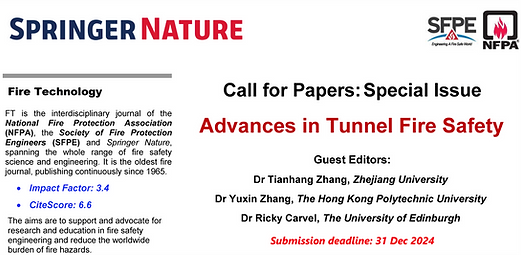
Fire Technology SI on Tunnel Fire
April 2024
The enclosed nature of tunnel spaces, combined with the high density of users and complex environments, makes them particularly vulnerable to fire incidents. This special issue will focus on novel concepts, applications, and perspectives of fire modelling and firefighting technologies in underground space. The Guest Editors include two PolyU Fire Lab members (Tianhang ZHANG and Yuxin ZHANG) and Dr. Ricky Carvel from the University of Edinburgh.

What controls Lightning Fire in North China
April 2024
Cloud-to-ground (CG) lightning is the primary cause of major boreal forest wildfires. We found that although lightning characteristics played a role, precipitation is the predominant factor controlling both the spatial pattern of lightning fires and ignition probability. Fewer precipitation intensities, both preceding and following CG lightning, matter for ignition. This work is in collaboration with Beijing Normal University and the University of Hong Kong and has been published in Agricultural and Forest Meteorology.

AI Improves and Accelerates Fire Simulation
March 2024
Fire modelling is widely known as very slow and not so accurate and realistic because it is challenging to simulate the burning process of solid/liquid fuel. Resolving the heat transfer between flame and condensed fuel requires tiny cells, making simulation solve and expensive. We use AI + fire image to predict the interface heat transfer so the burning process can be solved under larger cells. This work is published in Engineering Applications of Computational Fluid Mechanics, led by Caiyi Xiong and Zilong Wang.

PolyU Fire @ Battery Safety Conference
March 2024
Xinyan and Lei attended the 5th National Meeting on Lithium-ion Battery Safety in Beijing, organized by Tsinghua University. Xinyan was invited to give a talk titled Exploring the Limiting Cooling to Prevent Battery Thermal Runaway, which was the latest research from Lei Zhang’s PhD thesis. The talk receives positive feedbacks from both academia and the battery industry.

New paper on Laser Ignition of Battery
March 2024
Laser, as an excellent remote and spot heating source, can heat the battery and trigger the thermal runaways in a well-controlled way, which is particularly good for scientific research. Our latest paper quantifies the limiting conditions and heating efficiency of laser heating of a cylindrical battery, so it is valuable to make battery test standards. This work is published in the Journal of Energy Storage, led by Yanhui and Lei.

PolyU Fire Cycling
March 2024
PolyU Fire Lab organized a cycling event from Tai Wai to Tai Mei Tuk (~20km). We spend a lot of time sitting in front of the computer, so we should spend more time exercising and maintaining a healthy lifestyle! This is also a farewell event for Jakub before he flies back to Poland.

Digital Twin for Tunnel Fire
Feb 2024
High traffic flow in a confined tunnel makes fire safety a critical issue. This paper proposed a digital twin framework for tunnel fire safety management in real-time, driven by dynamic sensor data and AIoT technologies. The AI model is integrated into a 3D digital twin platform developed by the game engine Unity 3D. This work is part of the SureFire project led by Xiaoning Zhang and Yishuo Jiang from HKU. It is now open access in Developments in the Built Environment.

Xinyan got FCE Outstanding Young Teacher Award
Feb 2024
Dr Xinyan Huang receives the FCE Faculty Award for Outstanding Young Teacher. In total, only eight young professors are awarded this year. Dr Huang’s passion for teaching, combined with his profound expertise, has not only enriched the academic journey of his students but has also contributed significantly to advancements in Fire Safety Engineering.

Xinyan is Featured in Local Newspaper
Feb 2024
Dr Xinyan Huang was interviewed by Wen Wei Po (Chinese Newspaper funded in 1948) and featured on the whole page of the Newspaper as part of a Serial on Scientific Disaster Reduction. It introduces the latest research from PolyU Fire Lab, including the firefighting robot, fire suppression by air vortex ring, SureFire Smart Firefighting system, smoldering fire in peatland. The online version of this special report includes more details and video demonstrations.

FireDM: Generating Unlimited Fire Images
Feb 2024
One of the major issues in AI-driven fire detection and quantification is the lack of a good fire segmentation database. Our FireDM takes full advantage of the combined strengths of a combination of pre-trained diffusion models and text-guided diffusion using ChatGPT4-Fire to generate multi-scale and detail-rich fire images. Then, we use FireDM to create the world’s first high-quality fire segmentation dataset. This work is published in Knowledge-Based Systems, led by Hongtao Zheng.

New Book on Smart Firefighting
Feb 2024
Dr Xinyan Huang and Dr Andy Tam from NIST co-edited a book titled Intelligent Building Fire Safety and Smart Firefighting, published by Springer. This book includes 20 chapters and introduces the latest developments in Intelligent Fire Safety Design, Advanced Fire Identification, and Smart Firefighting Operations. This is the first book dedicated to the new concept of Smart Firefighting.

Review of Fire Smoke Model in Building Award
Jan 2024
Since the 1970s, researchers have developed semi-empirical models to describe fire smoke movement inside buildings, but there are three major issues. This paper depicts the cases encountered during the design over the past decades and provides detailed processes for solving these issues. This work was published in Emergency Management Science and Technology, led by Dr Mingchun Luo. It is a summary of Dr Luo’s years of research and practices in the fire engineering consultancy.

Ho Yin is Featured in HK TV Program
Jan 2024
Ho Yin and his start-up company, GABES, are interviewed by the HOY Seiral Program (Smart Future Technology, Episode 21) for their latest development of intelligent dynamics exit signs. Ho Yin has been conducting this research at PolyU since 2021, and later, he formed a start-up to commericalize this new technology and aim to improve life safety in a fire evacuation. So far, Ho Yin has received investments and angel funds of over 2 million.

See How Firework Ignite a Building Façade
Jan 2024
Every holiday, there will be massive fire incidents caused by fireworks. In our experiment, we drop a hot steel spherical particle (6-16 mm and 800-1200 °C) onto the low-density expandable polystyrene (EPS) foam to simulate the spotting ignition process. We found three different ignition behaviors under various wind speeds. This work enhances the comprehension of complex interactions between flash points and fire points in the spotting or hot-particle ignition of the building facades.

Effect of Fuel Type on Smoldering LOC
Jan 2024
Oxygen supply is a key parameter of smouldering and is sensitive to fuel density and particle size. We explore the oxygen threshold for smouldering propagation under upward internal airflow velocities for pine needles with different bulk densities and wood samples with different particle sizes. This work advances the fundamental understanding of smouldering on solid fuel particles and their smouldering fire risks. This work is published in Combustion and Flame as a part of Yunzhu’s PhD thesis.

Xiaoning Zhang Passed PhD Thesis Defense
Jan 2024
Xiaoning has successfully defended his PhD thesis, Smart Tunnel Fire Forecast and Safety Management Driven by Artificial Intelligence of Things, which is rated as Excellent. His thesis examiners are Prof. Long SHI from USTC and Dr Håkan Frantzich from Lund University. His supervisor team includes Dr Xinyan Huang (Chief Supervisor) and co-supervisors (Prof. Fu Xiao, Prof. Heng Li, and Dr Xiqiang Wu). Congratulations, Dr Zhang!

Can UG Smoldering Fire Trigger a Flame?
Jan 2024
This work explores whether such underground peat fires can resurface to the ground and ignite a flame on the litter layer. With lab-scale and field experiments, we found the threshold of such surface flaming to be a function of temperature and temperature increase rate at the interface between peat and litter. This work was led by Yichao Zhang in collaboration with Inner Mongolia Agricultural University and published in the International Journal of Wildland Fire with open access.